
Which snow attachment will work best for you? Find the right snow pusher, plow, or blower for your tractor, your property, and your budget.
We’ll help you put together a setup that makes sense.
Which snow attachment will work best for you? Find the right snow pusher, plow, or blower for your tractor, your property, and your budget.
We’ll help you put together a setup that makes sense.
How much snow falls?
Where you can put it?
What you want to spend?


Simple and very effective. Our starting point for many tractor owners with room to build a pile.
PROS
Great value. More control while pushing snow than plow. Backdrag pulls snow away from walls and garage doors.
CONS
Needs room to pile snow (lots of room).
BEST FIT
Driveways with open areas and room to stack snow (your yard is fine).
TYPE & AMOUNT OF SNOW
Any type of snow. A pusher full of wet snow is heavy, so try to clear every 6 inches or less.

Angle the blade and send snow to the side as you drive. A strong fit for long runs with space along the edges.
PROS
Straightforward to operate. Moves snow to the side as you drive, making it useful for long, continuous passes.
CONS
Spillover along your route is inevitable. Clears a narrower path when angled. Often costs more than a comparable pusher.
BEST FIT
Long driveways & room along the sides.
TYPE & AMOUNT OF SNOW
Any type of snow. As you are simply dozing snow to one side, the build-up on a second pass can be heavy. So tackle every 6 inches.

Throws snow beyond your clearing area. Many types to choose from including: rear facing, pull-type, frame-mount, and loader mount.
PROS
Throws snow beyond the clearing area, reducing the need for large piles. Can pull snow away from walls and garage doors.
CONS
Significantly higher cost. More potential maintenance. Wet, heavy snow can clog the chute. If using on open station tractor during windy conditions, driver may get blowback while operating.
BEST FIT
Limited stacking space.
TYPE & AMOUNT OF SNOW
Dry snow is better than wet, heavy snow. Best to clear less than 8 inches at a time.

With room to pile snow, a pusher makes a lot of sense. Its sidewalls help trap a lot of snow as you drive. The open bottom allows you to push to the pile, then immediately back away for another pass.
For many customers, a pusher is more efficient than letting snow spill off the ends of a plow. And pushers have no mechanical parts, hydraulic requirements, and almost no maintenance of any kind.

Winter is only half the story.
Clear your snow. Then convert your pusher into a light material bucket when winter is over. One attachment, more ways to use it.
MAKE IT PART OF YOUR VERSAFRAME SYSTEM
Choose the VersaFrame-compatible configuration to use with our modular attachment system.
The VersaFrame is also compatible with our pallet forks and stump bucket (with more attachments underway). And the VersaFrame includes a weight rack, 2-inch receiver, gooseneck receiver, and chain hooks.
BEST FIT
Owners who want their snow attachment to earn its keep beyond winter.

Built tough. Proven winter after winter.
We’ve sold and recommended HLA snow pushers for years. Industry-leading design and construction means we haven’t had a warranty claim to date.
FIND YOUR SIZE
Four series (1500, 1800, 2500, and 3400 Series) to match the width and power of your tractor to the work ahead.
BEST FIT
Owners looking for a dedicated snow pusher with a track record we trust.
Lots of new tractor owners think “I’ll just use my bucket to move snow.” And your loader bucket can move snow. But not very well.
Every single run ends with fully cycling your bucket to dump the snow. Not to mention jostling your bucket to shake out the stuck snow. It’s wasted time on every single pass.
Snow pushers lack a floor, so you lift and back away when you reach the end of your lane. A bucket requires you to tip out each bucketful (which takes much longer than you think)
Your snow pusher will trap more snow than your bucket can, leading to fewer passes overall.
Your bucket edge isn’t designed to protect concrete or delicate surfaces. If you bolt-on a cutting edge, you’re raising up your bucket to act like a mini-plow. A snow pusher doesn’t have this problem.
If you use your bucket to backdrag snow away from a wall, you’ll still need to come back and scoop it. A snow pusher can trap snow in the backdrag position and allow you to make an entire run in reverse.
Blowers costs more, but let you throw snow away from the clearing area.
But before you choose a snow blower, let’s talk about which way you’ll be facing.
With a conventional rear-facing 3-point snow blower, you back into the snow to clear it. That means looking over your shoulder through pass after pass. Fifteen minutes or an hour—it gets old.
A pull-type blower lets you clear while driving forward. Much better. But the blower is still behind you, so you’ll still look back to check how it’s doing.
Put the blower on your loader and keep the snow-clearing action in front of you. Drive forward, watch the blower work, and adjust the chute and deflector from your seat.
One more reason for our Snow Wrecker: It’s self-powered, meaning no mid-PTO or hydraulic power pack needed. Keep your loader installed and swap attachments when the next job comes along.
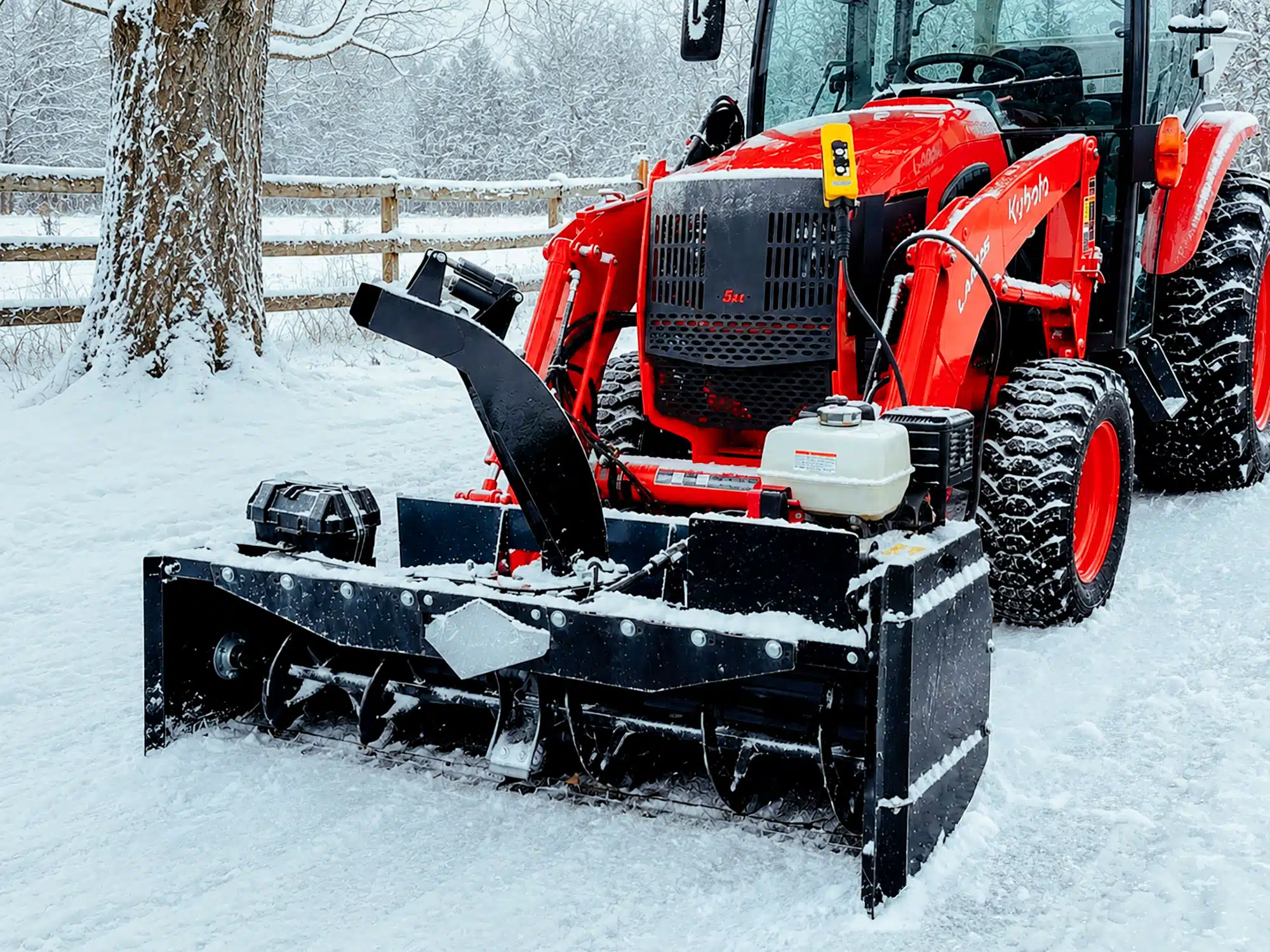
Your snow blower. Front and center.
Drive forward and watch the snow-clearing action ahead of you. The self-powered Snow Wrecker mounts to your loader, so you can keep your loader installed and swap attachments when the next job comes along.
CHOOSE YOUR FIT
54- and 64-inch cutting widths with JDQA or SSQA mounting options. UHMW skid runners are included. Match the blower to your tractor’s width and loader capacity.
BEST FIT
Owners who want the blower out front, convenient controls, and their loader available all winter.
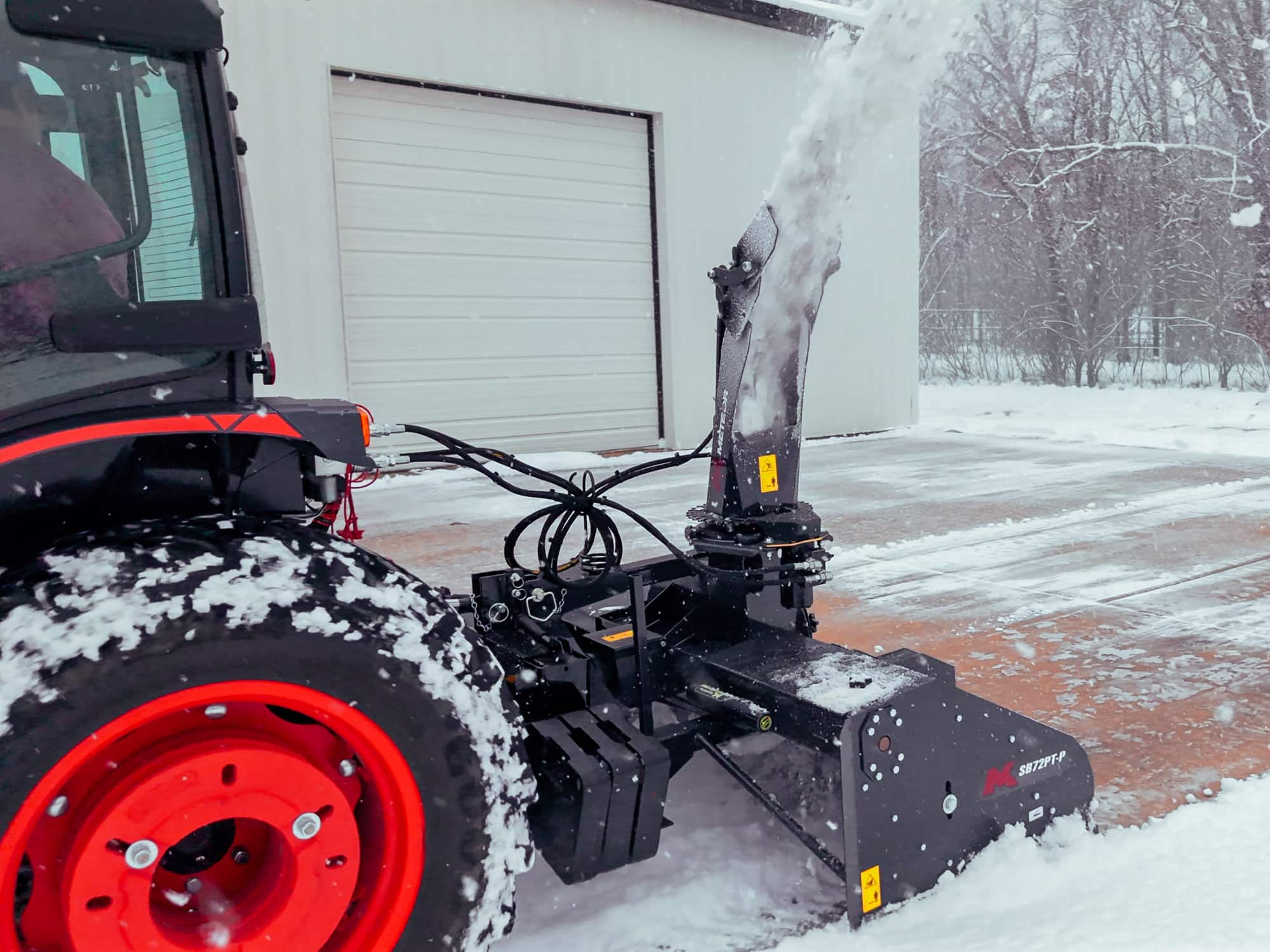
Pull forward. Leave the snow behind.
Clear snow while driving forward with this 3-point pull-type blower. The Performance design lets you back close to a garage door or retaining wall, then pull snow away without adding a separate backdrag.
CHOOSE YOUR FIT
Seven cutting widths from 54 to 97 inches. Hitch category, horsepower requirements, and chute control options vary by model. Your tractor travels through the snow first, and you’ll still look back to check the blower.
BEST FIT
Owners who prefer a rear-mounted blower and can drive their tractor through the snow they need to clear.
For long runs with space along the edges, an angled snow plow can be a good match. Move snow to the side as you travel.
Remember, angling the blade makes the overall width shorter, so you can often size up beyond your tractor’s footprint on a snow plow.

A robust loader-mounted blade with a spring-trip design and lateral float. Choose manual angling or a hydraulic upgrade.
For a full 8 ft snow plow, check out the 2000 Series Snow Blade
The right size, mount, cutting edge, and skid runners make a difference. We’re here to help you sort out the details.
Match the attachment to your tractor’s capabilities, connection style, and conditions. Send us your tractor model and what you’re clearing, and we’ll help narrow the size and options.
Yes, but gravel is finicky. It works best when the gravel is frozen solid. Otherwise move your cutting edge up higher than your skid runners, as they will sink into the gravel. And try our extra-wide skid runners made just for gravel. Lastly, it’s not a bad idea to leave a little ‘skiff’ of snow on top of the gravel, as it will help with traction.
UHMW is a hard, smooth plastic used for wear components. Available UHMW cutting edges and runners help protect paved surfaces. Options vary by attachment.
No. VersaPusher has several mounting configurations. Choose the VersaFrame-compatible option if you want to share a frame with other tools in the system.
Unbolt the pusher from its frame, invert it, and bolt it back on in the bucket position. The bucket is for light material; it is not intended for digging hard-packed or dense material.
Your tractor must travel through the snow before the blower reaches it. If depth or conditions prevent that, consider a different blower arrangement.
When you’re moving snow you need a lot of traction, particularly on your rear tires. This is accomplished largely through weight. If you’re using a pusher or a plow you can hang weight on your 3-point with a weight rack (we have a Counterweight Bundle), but you also might want Wheel Weights.
If you’re using a 3-Point snow blower, you could add Hitch Hangers to a quick hitch and also use wheel weights.
Tell us your tractor model, driveway surface, typical snowfall, and budget. We’ll help you choose the attachment and options that make sense.
If our recommendation doesn’t work for your machine, we’ll exchange at no cost to you.