How to Choose the Best Tractor for Your Property

How to Pick the Best Tractor for Your Property

If you’ve just acquired a big piece of property, one of the first and most important questions you’ll face is: which machine should I choose? It’s not a simple answer. The best tractor for maintenance depends on your acreage, terrain, budget, and the kinds of projects you want to tackle.

To help you think it through, we’re breaking down five key machines so you can make the most informed decision possible. This guide is based on real-world use across a 140-acre property featuring fields, heavy woods, steep hills, and pond frontage, which is a demanding mix that puts every machine to the test.

Would you like to watch the full tractor comparison? Check out our full video here:

Don’t forget to subscribe to the Good Works Tractors YouTube channel for more compact tractor hacks, safety tips, and attachment reviews.

The Top 5 Tractors for Your Property

Before diving into the pros and cons, here are the tractors we’re comparing:

Each of these sits in a different class, and each has a unique role to play in best property maintenance tractor decisions. Let’s walk through them one by one.

1. Subcompact Tractor: John Deere 1025R

When it comes to the best compact tractors for farm maintenance, the subcompact category often gets overlooked, but it shouldn’t be. The 1025R is the smallest subcompact tractor John Deere makes for best property maintenance tractor, yet it punches well above its weight class for the right applications.

What it does well:

  • Navigating tight trails and wooded areas with ease
  • Mowing your lawn with a mid-mount belly mower
  • Light loader work, food plot tilling, and trail maintenance
  • Fitting into spaces that larger machines simply can’t access

Where it falls short:

  • Large acreage applications take significantly longer
  • Deep tilling or aggressive grading is a stretch
  • Not ideal for heavy lifting or large attachment work

Note: Unlike the other best tractor for maintenance comparison, the 1025R does not offer a factory cab with air conditioning, something worth considering if you plan to run it hard in summer heat. To maximize its performance for loader work and uneven terrain, consider adding wheel weights for improved traction and stability.

2. Skid Steer / Compact Track Loader: John Deere 333G

If you had to sum up a skid steer in a single word, it would be power. The 333G is the largest skid steer John Deere makes, and for heavily wooded, overgrown properties, it can be a game-changer.

What it excels at:

  • Clearing overgrown fields packed with autumn olive and invasive brush
  • Running a hydraulic mulcher head for hours on end
  • Moving heavy logs, stumps, and large material
  • Operating comfortably on hilly terrain thanks to a low center of gravity and wide tracks

Stability on slopes: One of the most underappreciated advantages of a compact track loader over a tractor is the sense of security on uneven ground. Tractors, even wide ones, have a relatively high center of gravity and a narrower footprint, which can feel unsettling on steep hillsides. A skid steer with wide rubber tracks sits low and planted, even on aggressive slopes.

Visibility: All attachments mount to the front loader, putting everything right in your sightline through the glass door.

Where it falls short:

  • Skid steer attachments are hydraulically driven and can be expensive
  • High-flow hydraulic systems require beefier, costlier attachments
  • The machine purchase price is significant, especially at the top of the lineup
  • On rough terrain, a wheeled skid steer would struggle

Note: For heavily wooded or overgrown properties, a compact track loader may be the single most productive machine you can own in the first year of property development.

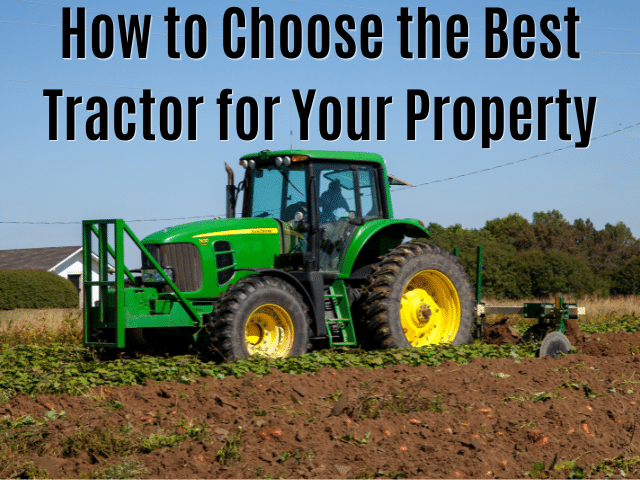
3. Large Compact Tractor: John Deere 4720

The 4720 represents one of the best compact tractors for farm maintenance, offering 66 horsepower, fully hydrostatic operation, and a factory cab with heat and air conditioning. This is where the tractor comparison gets interesting, because this machine involves frequent direction changes, such as loader work, grappling logs, or grading passes, a hydrostatic (HST) transmission is dramatically easier and more efficient than a gear drive. There’s no clutch, no shifting; just push the pedal forward or back.

What it handles:

Where it has limits:

  • Too large for lawn mowing duty
  • Not as purpose-built for “point-and-go” tasks as a gear-drive utility tractor

Note: For a 40–140-acre property with mixed terrain, woods, and fields, a large-frame compact tractor like the 4720 (or Kubota’s equivalent, the Grand L or L6060 series) may be the single most capable all-around machine available.

4. Utility Tractor: Kubota M4D-071

The Kubota M4D-071 at 73 horsepower is purpose-built for high-load, sustained-use applications. This is a gear-drive machine, which changes the use case considerably.

Best suited for:

  • Brush hogging large open fields for hours at a time
  • Snow pushing long driveways
  • Field plowing or tillage in one direction
  • Any “set it and forget it” task where you’re not changing direction frequently

Key advantages over compact tractors:

  • Runs cooler under sustained heavy load, critical during hot summers
  • Wider footprint (approx 7 feet) for improved stability
  • More horsepower for large attachment work

Disadvantages:

  • Gear-drive transmission means more shifting, less ideal for back-and-forth loader work
  • Too large for woods navigation or tight spaces
  • Overkill for properties without substantial open acreage

Note: This tractor shines when you have a long driveway to plow, a big field to mow, or a full day of brush hogging ahead. Though adding a 3rd function hydraulic kit can help expand operational flexibility

5. Mini Excavator: Cat 305 E2

The Cat 305 E2 is a dedicated digging and earthmoving tool, and on the right property, it earns its keep quickly.

Where a mini excavator truly shines:

  • Steep pond banks and waterfront areas that are too dangerous or unstable for other equipment with a low-slung excavator, it becomes approachable. 
  • Useful for driveway construction by cutting into hillsides, establishing grades, and setting culverts
  • Dedicated digging power makes stump extraction far easier than any loader
  • Suitable for drainage and utility work
  • Easily clear fallen timber from slopes

Choosing the Best Tractor FAQs

According to our tractor comparison, the large-frame compact tractor (like the John Deere 4720) is the single most capable all-around machine for properties in the 40–140-acre range with mixed terrain. It offers the ideal balance of power, versatility, and maneuverability for woods work, field mowing, and loader tasks.

Hydrostatic (HST) transmissions are ideal for frequent direction changes and loader work, with no clutch or shifting required. Gear-drive transmissions are better for sustained, repetitive tasks like brush hogging or plowing where you’re moving in one direction for extended periods. HST is more versatile; gear-drive is more efficient for single-purpose, high-load work.

For heavily wooded or overgrown properties, a compact track loader (skid steer) like the JD333G is often the most productive machine in year one. Its low center of gravity, wide tracks, and superior stability on slopes make it excellent for clearing and brush work. However, a subcompact tractor like the 1025R excels at navigating tight trails and tight spaces.

A mini excavator like the Cat 305 E2 fills a specific niche: steep pond banks, driveway construction, and stump extraction are tasks where dedicated digging power far exceeds what a tractor loader can accomplish. If your property has waterfront work or significant grading needs, a mini excavator is worth the investment.

Final Verdict

After all five tractor comparisons, the winner, if forced to choose just one, would be the large-frame compact tractor (John Deere 4720 or equivalent).

Here are the reasons:

  • Hydrostatic transmission: efficient for both loader and attachment work
  • Large PTO and three-point capacity: supports big brush hogs, tillers, grapples, and more
  • Front-end loader: handles logging, grading, snow removal, and material handling
  • Factory cab with heat and A/C: you’ll actually use it year-round
  • Right-sized: big enough for serious acreage, compact enough for woods work
0